Located right in the heart of Europe, this small country might surprise you. Smushed between France, the Netherlands, Germany, and tiny Luxembourg, it’s full of unique quirks and fascinating culture.
In this article, we’ll explore what makes it famous — from iconic foods and drinks to people, places, and surprising little-known facts.
Page Contents
15 Things Belgium is famous for
#1 The EU
Belgium, and Brussels in particular, is famous for being the de facto capital of the European Union, with a long history of hosting most of the EU institutions.
Officially, the EU has no capital and doesn’t plan on having one. Still, the European Quarter in Brussels hosts the European Commission, the European Council, the Council of the European Union, and the second seat of the European Parliament. It is believed that this presence accounts for more than 8% of regional GDP and 17% of employment.
Each day, Brussels is mentioned in almost every newspaper and TV program around the world because it’s where EU decisions are made, making it the foremost reason Belgium is known worldwide.
The Central location and accessibility, and the fact that it is not one of the major cities, helped Brussels achieve this status. Still, the story of how it became the EU’s capital is much more interesting.

#2 Internal division and languages
As we mentioned earlier, Belgium is a curious country. One that sometimes doesn’t seem to fit well together, but it somehow works. Belgium has three languages (Dutch, French, and German), all spoken in its communities. Plus, Brussels is a bilingual area where Dutch and French are spoken.
This historic linguistic diversity is both a cause and a consequence of many cultural and political conflicts throughout the country’s history. And to make things even more interesting, you should note that the Flemish community, which speaks Dutch, doesn’t consider itself Dutch, and the Walloon community, which speaks French, doesn’t consider itself French. Also, the German-speaking community is tiny and confined to the border with Germany.
So, it’s easy to understand why this internal organization is messy and difficult to manage, but also why it doesn’t fit with other countries. And it does get “interesting” from time to time…
#3 Longest time without a government in peacetime
Remember when we just talked about things becoming interesting? Well, that usually happens right after an election, when it becomes impossible to form a government. Belgium holds the curious record of “most time without a government in peacetime,” with an astonishing 589 days, well over Cambodia (354) and Iraq (289).
But you should note that this wasn’t a one-time thing… It has happened quite a few times, with many months to put together a working government. In fact, Belgium has done it again, and apparently broke its own record in 2020!
This must be one of the most curious famous facts about a country that we have ever written here! So, what is Belgium known for? Not having a government is definitely up there!
#4 Waffles
Waffles, or Goffres, are among the most popular foods in Belgium. Waffles have been a staple of Belgian cuisine for centuries, but they only became famous after the 1964 World’s Fair, where they were a huge hit. They were named Belgian Waffles, and the name stuck. However, in Belgium, there are dozens of regional varieties… The most popular are the lighter Brussels Waffles and the denser Liège Gaufres.
Waffles are a dish made with leavened batter or dough cooked between two hot, patterned plates that give it shape, size, and the typical checkered pattern. They are usually eaten as street food in Belgium, while elsewhere, it’s mostly seen as breakfast food. Either way, they are absolutely delicious!

#5 Belgian Chocolate
Belgian chocolate is one of Belgium’s most famous products and arguably one of the best chocolates in the world. The combination of quality ingredients, rigorous quality control, and production methods makes Belgian chocolate famous worldwide.
Belgium obviously doesn’t produce the raw cocoa; it usually comes from Africa and the Americas. However, they are passionate about chocolate and have been making it for almost 400 years.
There are over 2000 chocolate shops in Belgium, and it’s said that the place where most chocolate is sold worldwide is Brussels Airport, as people obviously love it and want to take it home as a souvenir. Some of the most famous chocolate brands include:
- Godiva
- The Belgian
- Côte d’Or
- Leonidas
- Neuhaus

#6 Fries
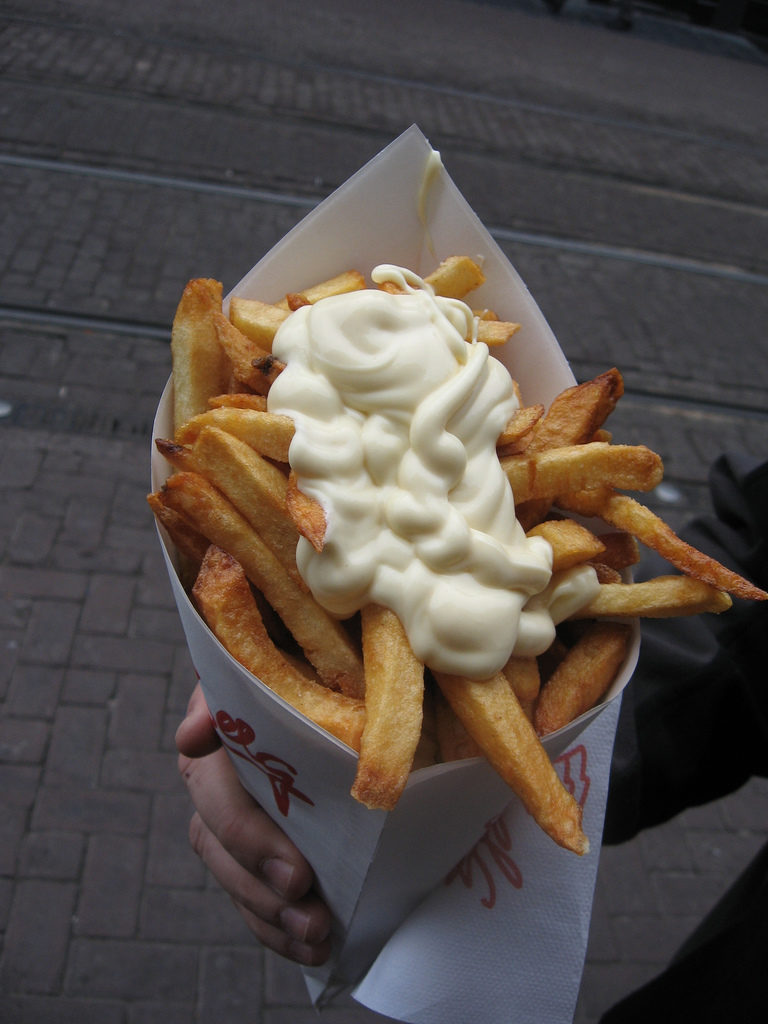
Belgian fries or French fries? There’s a debate about it, and no one is 100% sure of who invented it… Nevertheless, fries are very important to the Belgian people and an essential part of their heritage. You’ll find fries stands spread all over the country – depending on the language, they are called Frituur/Frietkot/Friterie.
The Belgians have made an art of frying potatoes. To get those delicious and crispy Belgian fries, they need to be 1 cm thick and be fried twice (the first fry should be at 150°C and the second at 175 °C). There’s even a special oil mix for frying potatoes!
Some of the most famous places to have Belgian fries are Maison Antoine in Etterbeek and Friterie de la Barrière in Brussels.
#7 Beer
Everyone knows beer is famous in Belgium, but only after visiting the country is it possible to fully understand the extent to which. Anyway, we will try to explain.
First, Belgian beer culture has been inscribed on UNESCO’s list of the intangible cultural heritage of humanity. So, beer is to Belgians what Fado is to the Portuguese, the tango to the Argentinian, or Thai massage to the Thais.
There are more than 300 active breweries in Belgium, from international companies to traditional breweries, including the famous Trappist beers from Trappist monasteries. Belgian beers have a massive array of varieties, from pale lagers to amber ales, lambic beers, sour ales, strong ales, Flemish red ales, and stouts!
One curious factor is that Belgian beer is usually drunk in bottles rather than cans, and each brand has its own unique-shaped glass.
The variety of beers and brands in supermarkets, pubs, bars, and restaurants is really impressive. It’s quite easy to get overwhelmed! Beer is genuinely something Belgium is famous for!
#8 Tomorrowland and other festivals
Even if you aren’t a fan of electronic music, you must have heard of Tomorrowland, right? It’s one of the biggest and most famous electronic music festivals in the world! Held in Boom, Antwerp (fitting name, right?), Tomorrowland lasts for weeks, and it’s extravagant… to say the least.
In 2019 about 400 000 people from all over the world come to Boom to enjoy the music, dance… and so much more! This festival can be a bit crazy!
In recent years, Tomorrowland has expanded to other countries, with festivals in Atlanta, US (called TomorrowWorld), Itu, Brazil, and Alpe d’Huez, France (in Winter).
#9 Diamonds
Belgium is famous for being home to the world’s diamond capital, Antwerp. More than 80% of the world’s rough diamonds pass through Antwerp, and about 50% of these diamonds return there each year to be cut and polished.
There are 380 workshops, 1,500 companies, and 3,500 brokers that employ more than 30,000 people. It’s an impressive world and a great destination if you are in the market for some diamonds…
Antwerp has been a significant player in the diamond world for centuries now, and it all started when Lodewyk van Berken revolutionized the industry by inventing the scaif—a tool for polishing diamonds. Belgium may not have diamonds, but they all (or almost all) pass through there.
#10 Waterloo battle
The Battle of Waterloo is one of the most famous battles in history. Fought in 1815 near Waterloo, Belgium, then part of the Kingdom of the Netherlands, it’s widely known as the battle where Napoleon Bonaparte was finally defeated, marking the end of the Napoleonic Wars.
The war was fought between France and two of the armies of the Seventh coalition—the British (plus the Netherlands, Hanover, Brunswick, and Nassau), led by the Duke of Wellington, and the Prussian army, led by Van Blücher.
In the place where the battle was fought, only 13km from Brussels, a huge monument called Butte du Lion (Lion’s Mound) was built—a large artificial hill made from dirt from the battlefield and topped by a giant lion statue. The topography of the battle was not preserved, but it’s a place of substantial historical significance.

#11 Comics
Comics are as crucial to Belgian culture as beer, chocolate, or anything else. It is one of the few arts in which Belgium has had an international and enduring impact, particularly during the 20th century. More than just for fun, Belgian comics are a way to understand Belgian culture and its way of seeing the world.
There are more comic bookmakers per square km than in any other country in the world. It’s also very easy to find comic book stores in the major cities and immerse yourself in this culture.
In Brussels, there’s even a very nice Comics museum. Many of the Belgian comics have jumped to TV and movies! Have a look at some of the most famous comics and authors:
- The Adventures of Tintin by Hergé
- Spike and Suzy (or Willy and Wanda) by Willy Vandersteen
- Spirou & Fantasio by Robert Velter
- The Adventures of Nero by Marc Sleen
- The Smurfs by Peyo
- Gaston Lagaffe y André Franquin
- Largo Winch by Philippe Francq & Jean Van Hamme
- Lucky Luke by Morris

#12 Cycling
Cycling is one of the most popular sports in Belgium. Belgians absolutely love it, and there are races almost every weekend. They are particularly enthusiastic about road racing and cyclocross, and that’s also where they primarily excel.
Some of the world’s biggest legends of the sport come from Belgium, including the most famous cyclist of them all: Eddy Merckx. But we also need to mention the likes of Tom Boonen, Johan Museeuw, Roger de Vlaeminck, Rik Van Looy, the former Olympic champion Greg Van Avermaet, Remco Evenepoel, and Wout Van Aert (a legend in both cyclocross and road cycling).
Some of the world’s most important races are also disputed in Belgium, particularly the famous monuments of Liege-Bastogne-Liege and the Tour of Flanders. Currently, there are also two world teams based in Belgium.
All in all, cycling is crucial for the Belgians; they love the sport like no one else. There are plenty of bike tours available, for all tastes, from accessible urban tours to riding in the legendary spots where the monuments are raced.
If you enjoy cycling, this is one of the must-do things in Belgium. You can also visit the Cycle Museum and the Tour of Flanders Centre to learn more about the sport and its intimate relationship with Belgium.

#13 Manneken Pis
One of Belgium’s most famous landmarks and attractions is a small statue on a small Brussels street. It has also been considered the most disappointing attraction in Europe several times! So, why is it so famous? Well, you probably already know it: it’s a statue of a little boy peeing. In more recent years, Jeanneke Pis (a little girl peeing) and Het Zinneke have also been created.
The original statue, created in 1619 in bronze by Jérôme, became an attraction and a beloved monument in Brussels. The Belgians love the Manneken Pis and usually dress it in beautiful and/or funny clothes. Even if you have only one day in Brussels, it is worth checking out this unique and fun statue.
The original is on display in the Brussels City Museum, while the replica that everyone visits is only a 5-minute walk from the Grand Place, at the junction of Rue du Chêne/Eikstraat and the pedestrian Rue de l’Étuve/Stoofstraat

#14 Famous people from Belgium
It’s the people who make each country great! Some become well-known and make the country even more famous. Belgium has had a few internationally famous people, including sportspeople, scientists, politicians, artists, and more. Let’s explore some of them:
- Eddy Merckx – nicknamed the Cannibal, he won 11 Grand Tours, the five monuments, and was a three-time world champion. It’s unanimously considered the GOAT of cycling.
- Adolphe Sax – inventor of the Saxophone.
- Gerardus Mercator – the famous cartographer who developed a world map to showcase a linear scale; he was born in Flanders before Belgium was founded, so he wasn’t actually Belgian.
- Rubens – one of the most famous Baroque painters. Similar to Mercator, he was born before Belgium was founded.
- René Magritte – Surrealist painter who created absolutely marvelous pieces like Son of Man and The Treachery of Images;
- Georges Lemaître – the scientist who refuted Einstein’s theory of relativity and authored the Big Bang theory.
- Hergé – the creator of Tintin;
- Jean-Claude Van Damme – actor and martial artist, best known for his action films like “Bloodsport” and “Double Impact”.
- Leopold II – the second Belgian king and the owner and absolute ruler of the Congo Free State from 1885 to 1908. But we will explore this further in the next and final thing Belgium is famous for.
#15 Congo atrocities
One of the things Belgium is famous for is for colonizing the Congo, and this isn’t a pleasant one… Congo was officially a Belgian colony from 1908 to its independence in 1960, though its history began in 1885, when the Congo Free State was created. The Congo Free State was a personal colony of Leopold II, the king of Belgium.
During its reign in the Congo Free State, it became one of the most famous scandals of the early 20th century. The atrocities perpetrated in Congo, including disease, torture, starvation, exhaustion, and lack of labor conditions, were, directly and indirectly, responsible for a considerable population drop.
There aren’t exact numbers, but modern estimations vary from 1 million to 15 million deaths. The expression “crimes against humanity” was coined to describe the actions taken during the Congo Free State Era.
Though it isn’t considered a genocide, as there wasn’t a deliberate attempt to erase a part of the population, it’s regarded as one of the worst atrocities ever committed.
So, what is Belgium famous for? Mostly great things like chocolate, beer, cycling, comics, but also a very dark time in Congo…
Looking for more information about Belgium? Have a look at these posts: