Last Updated on 9 months ago by traveldrafts
Yellowstone National Park, low population, and Cowboys are a few things we instantly correlate with Wyoming, but what is Wyoming famous for besides these?
Located in the USA’s Mountain West region, Wyoming shares a border with six states: Idaho to the west, Utah to the Southwest, Colorado to the South, Nebraska and South Dakota to the East, and Montana to the North and Northwest.
Nicknamed the Equality State, Wyoming was the 44th state to ratify the Constitution in 1890. It is a large state but very sparsely populated.
Page Contents
Ten Things Wyoming is famous for
Yellowstone National Park
Yellowstone National Park is the most famous thing in Wyoming and the first thing most people recall when talking about the state, as it is the most iconic and renowned national park in the USA.
This famous natural wonder of the United States is mostly located in northeast Wyoming but extends into Montana and Idaho. Overall, the park covers more than 2 million acres and attracts more than 4 million visitors each year.
Established in 1872, Yellowstone was the first national park in the USA and is home to diverse scenery and wildlife, including bison, bears, elk, and wolves.
Yellowstone is popular for its geothermal features, including geysers, mud pots, and hot springs. The most famous of these is the Old Faithful, a geyser that shoots up water up to 180 feet every 90 minutes. Other prominent geysers include Castle Geyser and Grand Geyser. And we cannot forget the Grand Prismatic Spring, the largest hot spring in the USA and one of the largest in the world.
Other main attractions in the park include the Yellowstone River, Yellowstone Lake, the spectacular Grand Canyon of Yellowstone, and several major waterfalls. There are also hundreds of miles of hiking trails where one can explore the vastness of the Park and see its marvelous wildlife.

Low Population
The 2020 US Census found that Wyoming had a population of about 576,851, making it the least populous state in the union. And by a lot, as it had almost 100,000 people fewer than Vermont and even more than Alaska and North Dakota.
On the other hand, Wyoming is the 10th-largest state, making it the second-least densely populated state at 6/mi². Yet, still very far from Alaska because of its enormous size.
The capital and largest city of Wyoming is Cheyenne in Laramie County in the southeastern part of the state. It has only 68,000 people, and its metropolitan area has about 100,000.
This is unsurprising as most of the state is mountainous and has a very harsh climate, which takes us to the next thing Wyoming is popular for.
Harsh environment
Wyoming is well-known for its harsh environment, with extreme weather conditions, particularly in winter. The winters in Wyoming can be brutal, with extreme temperatures, strong winds, severe thunderstorms, and blizzards.
The reasons for this are easy to understand: Wyoming is far inland, very far north, and at a relatively high altitude—the average elevation of the state is 6,700 feet.
And if this wasn’t enough, the state is also particularly windy because of the mountains, which create a funnel for winds from the Arctic. The same mountains block the passage of moist air, making Wyoming particularly dry.
Furthermore, the rugged terrain —several mountain ranges, sparse population, wild animals, and remote locations —helps reinforce its reputation as a challenging place to live and even visit. However, they are also among the reasons why so many people visit and love it.

Adventure sports and outdoor activities
The winters may be brutal, but the summers are enjoyable with mild temperatures. Together with the state’s top National Parks (Yellowstone and Grand Teton), state reserves, and natural monuments, it makes it an ideal destination for adventure and outdoor activities.
Wyoming’s natural beauty, vast wilderness, and abundant wildlife attract millions of visitors each year. Some of the most popular activities include:
- Hiking and backpacking – Wyoming has dozens of trails of varying difficulty and size. There are also some fantastic multi-day treks.
- Mountain biking – there are also many popular bike trails.
- Camping – It also has numerous campsites and Rv parks, perfect for a relaxing stay close o nature.
- Fishing – The rivers and lakes of Wyoming are some of the best in the USA for fly fishing.
- Wildlife watching – Grizzly bears, moose, elk, and wolves attract many people to Wyoming.
- Rock Climbing – Vedauwoo, Devil’s Tower, and Ten Sleep Canyon are very popular in the Summer.
- Whitewater rafting – Spring and early summer are the high season in Wyoming for whitewater rafting. There are some challenging rapids for adventurous but also easy, family-friendly tours.
- And more.

Cowboys and Old West
Wyoming is also deeply associated with cowboys and the Old West history. This has left a mark on state culture and identity, another attraction Wyoming’s tourism industry cashes on.
Due to its location and geographic features, Wyoming played a pivotal role in the American frontier and, consequently, in the development of cowboy culture in the 18th and 19th centuries.
The vast grasslands, open spaces, and sparse population attracted cattle ranchers from Texas and Kansas to the state, creating ideal conditions for ranching and grazing. Wyoming quickly became a cowboy state, and it played (and still plays) a vital role in the state’s industry and economy.
The state was also the site of many conflicts between Native Americans and the new settlers, including the Fetterman Massacre and the Johnson County War. Plus, Old West figures and legends like Butch Cassidy and the Sundance Kid lived in Wyoming and became notorious for their bank and train robberies.
Today, the cowboy heritage is rooted in Wyoming’s culture, and the old west image is strongly associated with the state, becoming a vital part of the tourism industry. Several working and guest ranches capture people’s imagination and give visitors an authentic taste of cowboy life.
There are cowboy festivals, rodeos, parades, and concerts to celebrate cowboy culture and attract people worldwide. The Cheyenne Frontier Days is possibly the most famous and one of the largest rodeos in the world.

Gender Equality
If there’s one thing Wyoming is historically famous for, it’s its progressive laws regarding women’s rights, particularly voting rights.
On December 10, 1869, Wyoming became the USA’s first territory (it wasn’t a state yet) to grant women the right to vote. This groundbreaking law led the women’s suffrage movement, which continued to gain momentum in the following decades. Still, it was not until the 19th Amendment to the US Constitution in 1920 that women nationwide were granted the right to vote.
The main reasons for this pioneering decision were the need to attract new settlers to the almost uninhabited territory and the assertive, vocal women’s movement at the time.
Wyoming is also the first state to have a female governor, Nellie Tayloe Ross, who served as the 14th Governor of Wyoming. However, she wasn’t elected; she assumed state control after William Bradford Ross’s death.
Since 1955, Wyoming has adopted the nickname “Equality State” to celebrate the state’s role in granting women’s suffrage and advancing equal rights for all citizens. The state motto is also perfectly fitting: “equal rights.”
Devil’s Tower
The Devil’s Tower is one of Wyoming’s most famous and iconic natural landmarks. Located in northeastern Wyoming, it is a sacred site for local tribes and a popular destination.
Also known as Bear Lodge Butte, it is a unique geological formation that rises 1,267 feet (386 m) above the Belle Fourche River, with a drop of 867 feet (264 m) from the summit to the base.
In 1906, Devils Tower and the surrounding area were established as the first national monument in the USA. One of the most iconic features of the tower is the hexagonal columns and the deep grooves, formed over millions of years by weathering and erosion.
Although each tribe has different stories and legends about the tower, it is considered a sacred site by several tribes, including the Lakota, Cheyenne, and Kiowa. Despite this tremendous spiritual and cultural significance, it is a popular hiking and climbing destination.

Hot Springs
Wyoming is known for its numerous and popular hot springs, particularly in the Yellowstone hotspot, which is responsible for volcanic activity in the region in the form of hot springs, geysers, and other geothermal features.
A hot spring is a natural pool of hot water heated by geothermal activity. Some are beautiful, others are popular for their relaxation and healing properties. The most popular hot springs in Wyoming include:
- Hot Springs State Park in Thermopolis has plenty of hot springs, including the enormous “Big Spring” that pumps about 3.6 million gallons of water at 135 degrees daily.
- Grand Prismatic Spring – The largest and most famous hot spring in Yellowstone.
- Saratoga Hot Springs is known for its high mineral content, which is said to have healing properties.
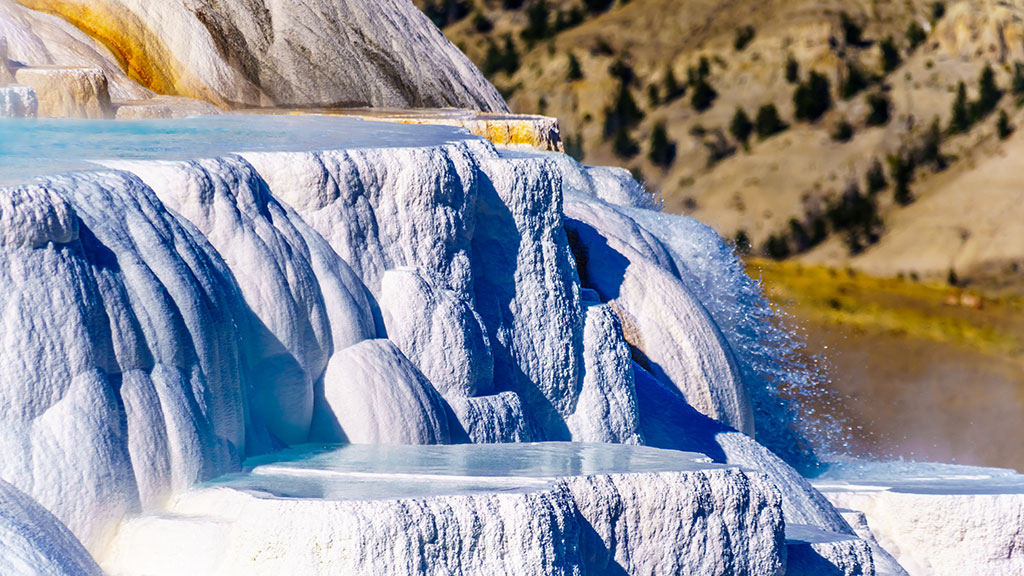
- Mammoth Hot Springs – a complex of hot springs that created a series of travertine terraces. Also, Yellowstone is very photo-friendly.
- Granite Hot Springs – turned into a pool, is popular for families and couples looking for a place to relax, soak, and swim.
Mining industry
What is Wyoming known for producing? With a significant mining industry, Wyoming is known for producing coal, oil, and natural gas.
Coal is significant because the state is responsible for about 40% of the United States’ production, making it the largest producer. It is also a major producer of natural gas and, more importantly, has extensive reserves of Natural Gas, Oil, and Uranium.
Besides the energy-related products, Wyoming also has large deposits and extractions of gold, copper, trona, uranium, and other minerals. In fact, Wyoming has the only active uranium mine in the United States.
While not as large as those in Nevada, Arizona, or Colorado, Wyoming’s mining industry is one of the state’s most important sectors, accounting for a significant share of the economy and jobs.
Fun facts: Wyoming is famous for
What is Wyoming known for? Many cool things, as we have seen above, but it is also home to many intriguing records, fun facts, and curiosities. Some of them are pretty well-known. Let’s examine a few of our favorites:
- Wyoming was named after the Wyoming Valley in Pennsylvania.
- The name originated from a Native American word, mecheweamiing, meaning “at the big plains.” It depends on who you ask.
- Wyoming has the second-highest average altitude of all US states, only slightly behind Colorado.
- Wyoming produces 85% of all soda ash in the USA.
- The Wyoming Toad is one of the most endangered amphibians in the world, with only a few hundred individuals remaining in the wild. It only exists in Wyoming.
- The pronghorn, native to Wyoming, is considered the second-fastest mammal on Earth, only slightly behind the cheetah.
- The Laramie County Library System is the country’s oldest continually operating county library system. It was established in 1886.
- The Granite Hot Springs in Wyoming’s Bridger-Teton National Forest is considered the world’s largest jacuzzi.
- The world’s largest population of wild horses lives in Wyoming.
- The U.S.A. bought Wyoming from France as part of the Louisiana Purchase in 1803.
- Kemmerer, Wyoming, is known as the Fossil Fish Capital of the World – it has over 100,000 fish fossils.
- All top ten largest coal mines in the United States are in Wyoming.


* Cover photo by f11photo via Depositphotos