Last Updated on 5 months ago by traveldrafts
Renaissance, gelato, and the Medici are among the things people immediately associate with Florence. Let’s explore these and other things Florence is known for.
Located in Central Italy, Florence is the capital and largest city of Tuscany. Its metropolitan area is home to about 1.5 million people, making it the 6th largest in Italy. Florence is about 275 km north of Rome, a 2.5-hour drive and 1.5 hours by high-speed train.
Florence is one of the most popular destinations in Italy and the world. As you would expect in Italy, it is an ancient city with incredible architecture and impressive landmarks. In fact, thanks to its former glory it has some of the most famous landmarks in Italy.
So, with no more delays, let’s examine what is Florence, Italy famous for?
Page Contents
10 things Florence, Italy is known for
Renaissance
The first answer to what Florence, Italy, is known for is obvious. Florence is known as the cradle of the Renaissance. It was in Florence that the Renaissance was born and most vigorous. At that time, Florence was the world’s wealthiest and most influential city.
The Renaissance is the period in European history that marks the transition from the Middle Ages to the Modern Age, spanning the late 14th to the 16th centuries. However, precise periodization is impossible, as it occurred at different times across Europe and there’s no major event to mark it.
Characterized by the effort to rediscover and surpass the ideals and achievements of classical antiquity, the Renaissance had its intellectual basis in a form of humanism that put the human at the center of all things. This radically new way of thinking manifested in everything from art to science and politics.
The Republic of Florence was the source of the Renaissance. The wealth accumulated in Florence, driven by its trade success and social, civic, and political peculiarities, made the Renaissance possible. With so much money to spend and the rediscovery of Greek philosophy, the wealthy citizens of Florence (and the Medici in particular) could afford to support artists, scientists, and thinkers, stimulating new ideas and artistic movements.
The Renaissance began and thrived in Florence, but other Italian city-states quickly followed. Venice, Genoa, Milan, and Rome were also essential in developing this new Era. Then, from Italy, it developed to the rest of Europe.

Medici
The Medici family was the most important and affluent in Florence during the Renaissance, when the city was one of the major centers of medieval European trade and finance and one of the wealthiest cities of the period.
The Medici’s initial wealth and influence came from wool production and trade, but their prominence grew mostly from banking and politics during the 15th century. During this period, the Medici Bank became the largest in Europe and one of the most prosperous and respected institutions in Europe.
At one time, the Medici were probably the wealthiest family in the world, which facilitated their rise in political power. Four Popes came from the Medici: Pope Leo X (1513–1521), Pope Clement VII (1523–1534), Pope Pius IV (1559–1565), and Pope Leo XI. They also received the hereditary title Duke of Florence, which was later elevated to the Grand Duchy of Tuscany.
The Medicis ruled Florence and created an environment where humanism, art, and science flourished, originating in the Renaissance era. They (and other families) were great patrons of the arts and sciences, financing the construction of grand monuments and the production of remarkable artworks. It is even said that they funded the invention of the piano and the development of opera.
The Medici were patrons of artists, architects, and thinkers such as Leonardo da Vinci, Michelangelo, Raphael, Brunelleschi, Botticelli, Machiavelli, Galileo, Francesco Redi, and many others, which brings us to the next thing Florence is famous for: its art and museums.

Art and Museums
The Renaissance Era and the Medici family left a considerable legacy in Florence. This legacy is visible everywhere in Florence as the city bursts with artworks, Renaissance buildings, and museums. When an art enthusiast thinks of Florence, they immediately think of museums full of Renaissance paintings, sculptures, and architecture.
About 80 museums in Florence house countless works of art, including some of the world’s most famous masterpieces. The most famous and popular museums in Florence include:
- Uffizi Gallery – the largest and most famous museum in Florence, it includes hundreds of beautiful artworks, including the Birth of Venus and La Primavera of Botticelli, the Venus of Urbino, painted by Titian, and many others.
- Pitti Palace – an enormous palace with impressive rooms and a vast collection of paintings, including several works by Raphael.
- Galleria dell’Accademia, where Michelangelo’s David is located.
- Palazzo Bargello (Museo Nazionale) – has an impressive collection, particularly of statues, including Donatello’s David.
- Palazzo Vecchio – an impressive building with several outstanding works of art and one of the best things to do in Florence. It also includes a visit to the Vasari Corridor, which was built to provide a safer, faster route to Palazzo Vecchio and the Uffizi.
Despite all the museums, you can also find impressive artwork in the city. For example, a replica of Michelangelo’s David is in front of Palazzo Vecchio. Or you can enjoy views of Brunelleschi’s dome from several city points. It is an overused expression, but in Florence’s case, it’s true: the whole historic center is a museum!

Banking
Besides the art and scientific revolutions, northern Italy was home to another revolution: the creation of modern banking. As usual in this era, Florence was one of the leaders, where most of the prominent players emerged. However, prosperous cities like Lucca, Siena, Venice, and Genoa were also pivotal.
Modern banking can be traced back to the Renaissance, when many innovations emerged. The first known deposit bank was Banco di San Giorgio, founded in Genova in 1407, and the oldest continuously operating bank is Banca Monte dei Paschi di Siena, created in Siena in 1472.
Nevertheless, the affluent families from Florence dominated banking in this period. During the 14th century, the Bardi and Peruzzi families established branches that spread throughout Europe, lending money to risky enterprises, particularly to finance the monarchy and their wars.
The Medici Bank was possibly the most famous and influential bank of the 15th century. Created in 1397, it was the financial arm of the all-powerful Medici family. Though it only lasted until 1394, it was Europe’s largest and most respected bank during its prime.
The Medici bank was also a pioneer in banking, contributing to its evolution from early medieval banks to modern banking by improving the general ledger system by developing the double-entry system of tracking debits and credits.
They are not the most fashionable inventions, but they were pivotal in wealth creation, allowing everything else, like the impressive landmarks we love today.

Impressive landmarks
The rich history of Florence gave rise to some of Italy’s and Europe’s most famous landmarks. They are mainly medieval and Renaissance buildings designed by some of the geniuses living in Florence at the time.
As we said earlier, Florence was one of the most important cities in the world, attracting artists and scientists who created some of Europe’s most impressive monuments. We are talking about geniuses like Brunelleschi, Giotto, Michelangelo, Donatello, da Vinci, and Vasari, among many others.
This massive concentration of wealth and talent left a beautiful mark on Florence. Some of the most well-known and impressive landmarks are:
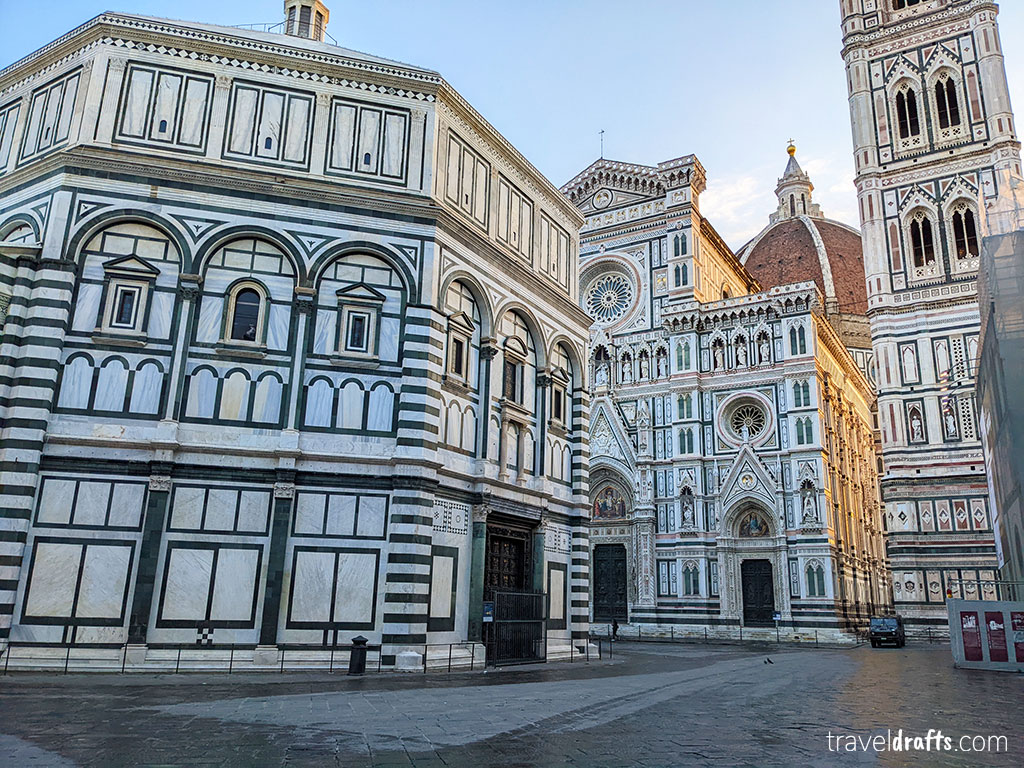
- Santa Maria Del Fiore with Brunelleschi’s dome and Giotto’s Tower
- Baptistery of St. John
- Uffizi Galleries
- Pitti Palace and Boboli Gardens
- Ponte Vecchio
- Palazzo Vecchio
- Vasari’s Corridor
- San Lorenzo Basilica
- Santa Croce church
- Bargello Palace
All these monuments and landmarks make Florence the most popular among all the best Tuscany destinations to visit. In fact, it is one of the most popular in Europe and the world. However, we will explore Florence’s popularity more below.
Leather
Florence and its surrounding regions are the largest leather producers in Italy and are famed for the quality of their products. The tradition of producing and working leather dates back to ancient times, when proximity to the Arno River provided the enormous water supply needed for tanning.
This century-long tradition is still kept alive by artisans who continue to love crafting leather by hand. Their leather is exceptionally soft and supple, but they continue to develop new textures, embossing, and colors.
While walking through Florence, you can find endless shops selling leather jackets. So many stores and markets in Florence offer leather jackets that it can be overwhelming. Though one thing is for sure, you won’t have problems finding where to buy a traditional leather jacket.
Huge tourist crowds
It is no secret that Florence is a fantastic tourist destination. It offers excellent food, beautiful monuments, museums, and a long and fascinating history. Plus, everything is in a relatively small walkable area. It is perfect for romantic escapades, solo travelers, and groups.
The problem? Well, everyone knows this: almost everyone has a good reason to go to Florence, which attracts millions of visitors each year. In 2019, there were about 16 million overnight stays in Florence, a city of less than 400,000 people, where you can walk from north to south in about 20 minutes.
Many people in a small place mean huge crowds, particularly in the Summer. However, we should note that Florence is crowded the whole year. When visiting Florence, we need to expect crowds at all times.
Though we are not complaining (well, maybe a bit), the city is amazing, and it’s only normal that so many people want to experience it, as do we and probably you. Just be prepared for it. One of the best ways to escape the crowds is to go to one of Florence’s many fantastic rooftop bars. You will still enjoy the city’s beauty and find some excellent Italian food in most of them.

Bistecca alla Florentina
Bistecca alla fiorentina is possibly the most famous dish from Florence. It is thickly cut and a huge Tuscan T-bone steak. You won’t have any problems finding this delicacy, and it is on many restaurants’ menus – many of them claiming they have the best Bistecca in town.
The origin of the name Bistecca alla Fiorentina is curious. Legend says that Bistecca is a corruption of the words “beef steak.” During the Renaissance, a few English knights were waiting to be served and began loudly asking for beef steak. The Italians liked the name, and it stuck. So, bistecca alla fiorentina simply means Florentine beefsteak.
The Bistecca alla Florentina is a simple dish with few ingredients but a very detailed process. The meat typically comes from Chianina cattle (though several other breeds are used) and should be aged for at least two weeks in cold rooms and at room temperature when cooking. The cut should weigh at least 1kg and have a height of 5-6cm (two to three fingers)
The Bistecca is grilled over red-hot coals and should be turned only once after cooking for 3 to 5 minutes per side. No more than that, as this is a rare cooking dish. The outside forms an aromatic crust, while the interior is soft and red with myoglobin.
Gelatos
Gelatos, or ice creams, are typical desserts in Italy and one of the things people associate with Florence. The true origins of Ice Cream are unknown, and it isn’t hard to believe that at some time in history, different people came up with the idea of mixing ice or snow with something sweet.
Very early records of frozen drinks or sweets are being consumed in China, Persia, and even Sicily. However, these were much more similar to sorbets than to ice cream. The turning point in creating ice cream came during the Renaissance, when the simple mixture of ice and sweets became the pasty, creamy gelatos we love today.
This change occurred in Florence when eggs, milk, and sugar were added to the ice, creating dense, soft gelatos. Then all the other flavors were added. And, Italians being Italians, made an art out of it, elevating ice creams to their perfection. The new invention quickly spread through European courts, but it became readily available to the public only much later.

So, besides being one of the best things to do in Florence, having a gelato is also a historical and cultural experience. Even if it weren’t, it would be all good—Italian gelatos are absolutely delicious.
Pin for later
