Located in the heart of Europe, Belgium is covered with fantastic destinations and attractions. Brussels is the capital, the biggest city, but also where you’ll find a huge number of Belgian Landmarks. Yet, cities like Bruges, Ghent, and Mechelen have lovely historical centers with some major landmarks. And then, there’s Leuven with its unbelievable city hall! Here, we will cover these and other famous landmarks in Belgium!
Planning a trip to Belgium? Have a look at the 50 things you need to know before traveling to Belgium!
We have invited some of our fellow bloggers to pitch in and get you the most complete and informative list of Landmarks in Belgium.
Page Contents
Famous Belgian Landmarks – Brussels
#1 Grand Place
La Grand Place, or De Grote Markt is the central square of Brussels, where people gather to celebrate or simply to meet each other. Considered by many to be one of the most beautiful squares in Europe, it’s one of the most remarkable landmarks in Brussels. Consequently, it’s always bustling with life, crowded with tourists and locals alike.
With roughly 110 by 68 meters, the Grand Place is surrounded by luxuriant guild halls and two larger edifices, the Town Hall and the King’s House (today contains the Brussels City Museum). UNESCO recognized its importance in 1998 when it declared it a World Heritage site.
Obviously free to explore, the Grand Place is more than a mandatory destination in Belgium, it’s where you should start your trip. You’ll be able to explore some of the most imposing buildings in Brussels and then take a break while eating a famous waffle, chocolate, or drinking a Belgian Beer.

#2 Manneken Pis
Only a 5-minute walk from the Grand Place, the Manneken Pis is located on the corner of Rue de l’Etuve and Rue du Chêne. Yet, if it wasn’t for the crowds surrounding it, you could easily miss it.
Manneken Pis literally translates as “little boy peeing,” and that’s exactly what it is—a bronze statue of a naked little boy peeing into the fountain’s basin. The Belgians simply adore this statue; it’s almost a national symbol as it represents their sense of humor and independent thinking. They even dress it up with a variety of clothes, from Halloween costumes to pop culture and historical references.
The Manneken Pis is a weirdly bizarre landmark in Belgium and the world, which is why it became so famous. Though you should know the statue is tiny, you won’t be disappointed when you get there.
The original statue dates back to the 17th century and was designed by Jérôme Duquesnoy the Elder. The statue seen on the street is a replica from the 1960s, while the original is in the Brussels City Museum.

#3 Atomium
Located on the Heysel Plateau in Brussels, the Atomium was built for the 1958 Brussels World Fair. This Belgian Landmark stands 102 meters tall and has nine balls, 18 meters in diameter. As a whole, it forms the shape of a unit cell of an α-iron (ferrite) crystal magnified 165 billion times. So, it’s fair to say that’s a unique building and clearly one of the most famous landmarks in Belgium.
Curiously, like the Eiffel Tower, the Atomium was supposed to be temporary, but it quickly became part of the city’s landscape. Its popularity led the city’s authorities to keep it, and in 2004-2006, it was fully renovated.
Today it works as a museum, and on top, there’s a restaurant with panoramic views of Brussels. This is an attraction worth seeing mainly from the outside, thanks to its unique shape; the interior can be a little disappointing. There’s nothing very attractive in the interior.

#4 EU Parliament
By Džangir Kolar from Dr Jam travels
The European Union has a parliament in two locations, and one of them is in Brussels (the other is Strasbourg). So when you are in the city, don’t miss a chance to visit this temple of European democracy. The entrance to the parliament is close to Station Europe at Place du Luxembourg. You can arrive at the EU Quarter – Espace Léopold by bus 12 or 95, metro 1, 2, 5, 6, or 7, taxi (basic fee is €2.40, the kilometer price is €1.80), or intercity train.
Tours of the building’s complex, built from 1989 to 2004, can begin with a visit to the Parlamentarium, a permanent exhibition featuring hundreds of multimedia components that explain the EU institutions in the 24 official languages of the EU. But the highlight of the visit is the European Parliament Hemicycle, a semicircular-shaped debating chamber, plenary chamber with more than 700 seats.
From the balcony, you can even listen to their session for an hour. Visits are free of charge, but booking is required for groups and individual visitors. There is also a smartphone app that lets you find information and multimedia about this place. After the visit, you will understand the importance of this parliament, where decisions made shape the lives of almost half a billion people.

#5 Halle Gate
By Dymphe from Dymabroad
One of Belgium’s best landmarks is the Halle Gate in Brussels. It is located very close to Bruxelles-Midi railway station and you can easily walk there. Also, there is a metro station next to it called Porte de Hal/Hallepoort. Moreover, it is close to the Palace of Justice so that you can visit both. The Halle Gate was built in the 14th century and is an old city gate that was part of the city walls of Brussels. The other city gates and city walls of Brussels were removed, but the Halle Gate was kept to serve as a military prison.
Throughout the years, it was also used for several other purposes, such as a church. Nowadays, you can visit a museum inside the Halle Gate. This museum focuses on the building itself, the city of Brussels, and its defense. The Halle Gate is not a UNESCO World Heritage Site. However, it is a fascinating place that you should definitely visit! Also, because it is very interesting and very centrally located, it fits well if you only go to Brussels for one day.

#6 Royal Palace of Brussels
By Mayuri from ToSomePlaceNew
The Royal Palace of Brussels is the Belgian Monarchy’s administrative residence. It is the official worksite, from where the monarch works daily alongside the staff members. Belgium is a constitutional monarchy with a hereditary head of state, titled King or Queen of the Belgians.
The Royal Palace is located on Rue Brederode 16, in Brussels, Belgium. It is just a short walk from the Brussels Tourism Office and the popular Grand Place.
The construction of the palace took decades, more than a century in fact. Construction began in 1783, and the palace was completed and opened in 1934. The palace was designed in beautiful neoclassical architecture, and four architects contributed to the project: Alphonse Balat, Tilman-François Suys, Henri Maquet, and Ghislain-Joseph Henry.
Although not a UNESCO World Heritage Site, the Royal Palace’s architecture and its close proximity to the Grand Place make it a wise addition to your itinerary, even if you have just one day in Brussels.
At the Brussels palace, the King receives the representatives of heads of state, ambassadors, and other guests, so it is not open all year round. During the summer months, visitors can explore the palace’s interiors. At other times of the year, tourists can only explore the palace’s exteriors.
The Royal Palace of Brussels is no longer used as a royal residence, as the monarchy resides in the Royal Palace of Laeken on the outskirts of Brussels. This palace is solely used as a work/administrative building.

#7 The Galeries Royales Saint-Hubert
By Chloe from Chloe’s Travelogue
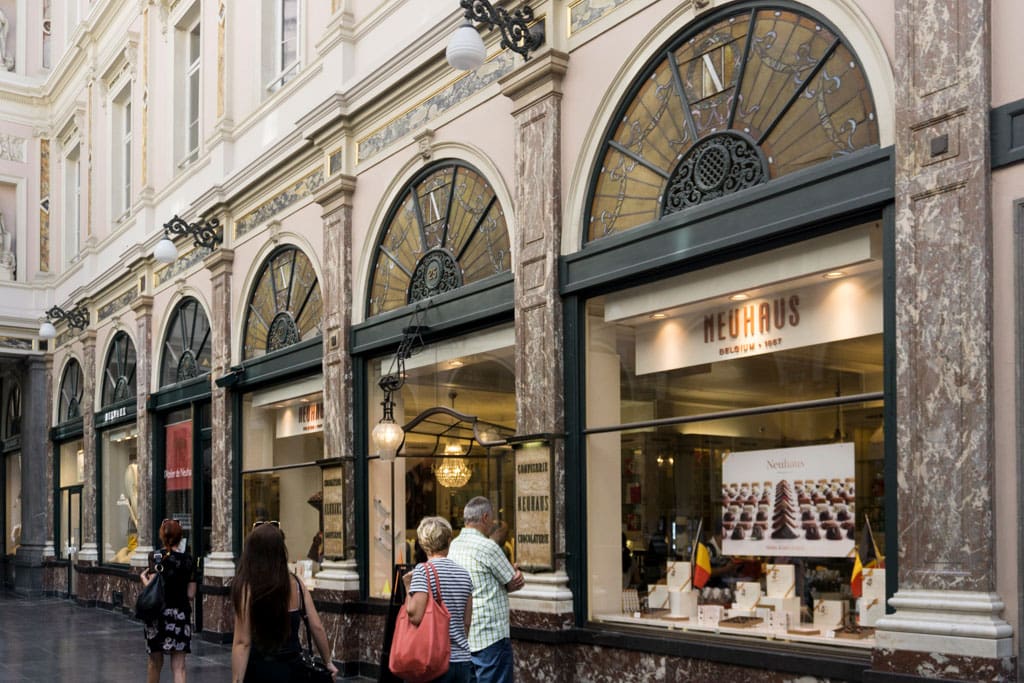
The Galeries Royales Saint-Hubert (“Royal Galleries of Saint Hubert” in English) is a historical shopping center you must include in your Brussels itinerary.
While the upscale shopping center is only 200 meters long and relatively small by today’s standards, it has made it to UNESCO’s Tentative List in the cultural heritage category for its architectural beauty and historical value.
The luxurious passage arcade was designed and built by architect Jean-Pierre Cluysenaer in 1847. It is one of the first shopping malls in Europe. In fact, its charming architecture with twin facades and an arched glass roof has inspired the Galleria Vittorio Emanuele II in Milan and other 19th-century shopping arcades.
Today, the Royal Galleries house high-end specialty boutiques, restaurants, and two theaters. If you have an eye on Belgian pralines, it is also a fantastic place to go self-guided Belgian chocolate tasting. The four most notable artisan chocolatiers are right here in one place, so sample to see which famous name you like best.
No matter how many days you are in Brussels or your interests, there is no excuse not to swing by the Royal Galleries, conveniently located in the city center. Get inspired by its gorgeous architecture, savor the world’s best pralines, and shop for some souvenirs! It surely is a destination worthy of your visit.
#8 The Cinquantenaire Arcade
The Cinquantenaire Arcade is a triple triumphal arch in the Parc du Cinquantenaire in Brussels. King Leopold II built the arc on the 50th anniversary of Belgian independence. Although it was supposed to be built in 1880 for the National Exhibition, it was not completed until 1905, on its 75th anniversary.
The monumental arcade is impressively tall at 45 m. On top of the arcade, you will find a statue of four houses with a woman charioteer raising the National Flag, and several sculptures below that personify the Belgian provinces. Beside the Cinquatenaire Arcade are the Military Museum, the Art and History Museums, and the Autoworld pavilion.
Besides the arcade, the Parc du Cinquantanair, or Jubelpark, is a pleasant place to visit and relax. With picturesque gardens, ponds, and waterfalls, it is the ideal spot for a walk, picnic, or run. In the Summer, it even hosts a drive-in cinema. On the north-western corner of the park, you can even find a beautiful Great Mosque of Belgium.
The Cinquatenaire Arcade and the park is easily reachable by metro (Schuman stop) or within walking distance from the Royal Palace of Brussels.

Famous Landmarks in Belgium – Flanders
#9 Tyne Cot Cemetery
By Emma Caldwell from Emma Jane Explores
Located in the Ypres Salient around the infamous Flanders Fields of World War 1, the remarkable Tyne Cot Commonwealth War Graves Cemetery and Memorial is a must-visit in Belgium to truly grasp the enormity of the sorrows of the Great War. It is, in fact, the largest cemetery housing the bodies of Commonwealth soldiers in the world.
The cemetery features rows and rows of white headstones marking the remains of soldiers who fought and died in battle– many without names. Horrifyingly, around 70% of the burials at Tyne Cot are unnamed, hence the large stone walls around the cemetery become a memorial to the missing with names of missing soldiers inscribed.
The nearest town to Tyne Cot Cemetery is Ypres, and buses run from there to the cemetery, taking around half an hour. Alternatively, Tyne Cot can be accessed on a day trip from Bruges, either by public transport or via a small-group tour – the Flanders Fields Battlefield Daytours is highly recommended and visits several other significant sites from the war.
Whilst not a UNESCO World Heritage site like many other places in Belgium, the solemn significance of this part of the country and the sacrifices made by so many during the war years in Flanders make the Tyne Cot Cemetery an integral part of any history-lover’s visit to Belgium.

#10 Menin Gate
By Ella Moore from Many More Maps
In the historical town of Ypres, you’ll find the Menin Gate, a huge First World War memorial to the missing soldiers of Britain and the Commonwealth. Etched into the stone walls of the Menin Gate, you’ll find the names of over 54,000 missing soldiers.
The Menin Gate is one of the city’s biggest tourist attractions and one of Belgium’s most iconic landmarks. The Commonwealth War Graves Commission chose Ypres as the site to erect the memorial in remembrance of the sheer amount of fighting that took place there. There were five Battles of Ypres during the First World War!
Although the Menin Gate is worth visiting at any time of day, night is best. This is because, at 8 pm every evening, buglers from the town play “The Last Post,” a bugle call that used to be played in the British Army to mark the end of the day. This is followed by a series of speeches and sometimes songs to pay respects to the missing soldiers. The Last Post Ceremony at the Menin Gate happens every night, even on Christmas Day, and is hugely popular with visitors to the city.

#11 Basilica of the Holy Blood in Bruges
By Trijit Mallick from BudgetTravelBuff
Belgium is not all about gorgeous architectural buildings, popular Belgian chocolates, or other famous things, but also about religious places and beautiful churches. The Basilica of the Holy Blood is a 12th-century chapel in the corner of Burg square.
This Roman Catholic basilica consists of two levels of chapels on top of each other: a Romanesque lower chapel and a Gothic upper chapel. The Basilica of the Holy Blood is just 1 km from the Brugge station. You can take the Line 12 bus or a taxi (takes around 7 minutes) to reach the basilica.
It is a very quaint and sacred church and one of the busiest tourist attractions in Bruges. You can see the colorful wall paintings and stained-glass windows as you go upstairs to the basilica. There is a holy relic containing a cloth soaked in the blood of Jesus Christ, displayed in a glass case. Each person gets a few seconds to view the sacred cloth.
There is a myth that after the Crucifixion, Joseph of Arimathea wiped the blood with a cloth from Christ’s body and preserved the holy cloth. Whether you are a believer or a non-believer, you will surely appreciate the beauty of this religious site.
There is no entrance fee; however, you can give donations to help maintain the chapel. Make sure to dress modestly while visiting this religious site in Bruges.

#12 Belfry of Bruges
By Dave Chant from Dave Chant
Bruges is often described as a “chocolate box” town, popular with tourists since the late 20th century – it is also the 7th most populous city in Belgium. Probably the most famous symbol of Bruges is its Belfry, which sits in the central Markt square of the old town. In fact, you can see the Belfry from almost everywhere in Bruges, and from the top of the Belfry, you can see almost all of Bruges. This alone makes it a fascinating building to visit.
It’s a 13th-century Medieval tower with an impressive carillon housing 47 bells. Belfries were important buildings for storing city documents and serving as watchtowers. They even have different bell sounds for different uses – to signal the start of the day, danger, and so on.
Sadly, the Belfry’s history has not been without tragedy. It was destroyed by fire in 1280 and rebuilt. The upper stage was added in 1483, but a lightning strike in 1493 reduced the spire to ashes. Again, in 1741, the rebuilt spire went up in flames and has never been replaced, so the building is lower than it was originally built.
There are still 366 steps to the top, and though 83m high does not seem like much, you’ll have views across the town. The Belfry and the old part of the city are so beautiful that they have been UNESCO listed since 2000.

#13 Beguin Houses of Bruges
By Jane and Duncan from To Travel Too
What is a Beguin House? Wikipedia states, “A beguinage, from the French term béguinage, is an architectural complex which was created to house beguines: lay religious women who lived in community without taking vows or retiring from the world.”
In Bruges, the Beguin Houses are located at Begijnhof 30. This UNESCO World Heritage site is one of Bruges’ most popular attractions. The entrance to the Beguin Houses is via a small bridge and a gatehouse that dates back to 1776.
You can visit on your own, or it is included in a walking tour of Bruges. The 16th–18th-century white Beguin Houses are enclosed in a walled neighborhood. They are now home to the Monastery of the Vineyard, run by the Benedictine Sisters.
The 17th-century Begijnhof Church is dedicated to St Elizabeth of Hungary. The Benedictine Sisters conduct daily services in the Church. The Museum is located in one of the 17th-century houses and houses items from the Beguines.
Entrance Fees: Free to visit the houses and the Church; Museum: 2 Euros per person.
Best time to visit: Springtime, when the grounds are covered in bright yellow daffodils

#14 Antwerp Central Railway Station
By Chrisoula Manika from Travel Passionate
Situated in the city’s heart, Antwerp Central Railway Station is also called Middenstratie (Middle Station) and Spoorwegkathedraal – the Railway Cathedral. It is an absolutely stunning railway station, one of the most beautiful in the world. If you find yourself in Antwerp, allow time to stop, look up, and marvel at its engineering.
The railway station was built over ten years between 1895 and 1905 and featured a stone railway building with a 75-meter-high glass dome above the waiting room. There is a vast train shed in glass and steel, measuring 285 meters long and 44 meters high. King Leopold II commissioned the station as he felt that the city should have a prestigious railway station.
He chose the local architect, Louis de la Censerie, for the work. The architecture is certainly fascinating, featuring 20 different types of marble, Doric, Tuscan, Ionic, and Corinthian-style columns, and a huge monumental clock in the main hall.
Between 2000-2009, the station was completely modernized and expanded to accommodate high-speed trains from Paris and Amsterdam.

#15 St Rumbold’s Cathedral in Mechelen
By Nichola from Family Hotel Expert
St. Rumbold’s Cathedral is one of the great sites in the picturesque city of Mechelen. Completed in 1520 and taking more than 300 years to build, it is an imposing structure visible across much of the city. This UNESCO World Heritage site has a quirky shape due to the original plans, which included a further tower that was never built.
Today, you can climb the 538 steps to the top, right into the bell tower for spectacular views across the city. On clear days, you can even see as far as Brussels and Antwerp. The tower is the site of one of Mechelen’s most legendary moments when, in 1687, a man emerged from one of the city’s bars and, seeing the moon shine on the tower, believed it to be on fire. Raising the alarm, a chain of townsfolk passed buckets of water along the line until, reaching the tower, it was clear there was no fire. The town has been known for its De Maneblussers, or The moon extinguishers, ever since! If you’re enjoying family holidays in Belgium then don’t miss Mechelen and the chance to climb its wonderful St. Rumbold’s Cathedral tower.

#16 Leuven town hall
The Leuven town hall is possibly the most elegant landmark in Belgium. Luckily, a day trip to Leuven is easy and relaxing, allowing you to see this stunning Belgian landmark and the rest of the city.
The Town Hall is truly an unforgettable building with ornate architecture, crafted in lace-like detail. Constructed between 1448 and 1469 in a Brabantine late Gothic style, the Leuven town hall is a wonder to look at, covered with 236 statues in canopied niches, and the corbels supporting the statues are carved with Biblical scenes in high relief. The details are astonishing up close, and from afar, we can appreciate how magnificent it is as a whole, with the four corner turrets, two ridge turrets, and a balustrade around the building.
Besides its spectacular architectural design, the town hall has beautiful interiors and cellars, as well as a huge number of statues and paintings to explore across the three floors. There are also daily tours of the rest of the building, during which a guide will explain the details of this Gothic gem’s construction. For example, the statues representing biblical figures, scholars, eminent citizens, artists, judges, dukes of Brabant, and even Napoleon that adorn the exterior weren’t part of the building until the 19th century.

#17 Gravensteen (Castle of the Counts)
By Sarah Vanheel from CosmopoliClan
In the heart of Ghent, the enchanting city between Brussels and Bruges, stands a fortress dating back to the 9th century. Its strategic location on the Lys River made the (then wooden) structure an excellent base for defending the city against the Vikings.
Over the next centuries, the counts of Flanders commissioned countless rebuildings. It wasn’t until the 12th century that Count Philip of Alsace, in an attempt to outdo the then-thriving city’s merchants, who flashed their wealth, had it transformed into an impressive stone fortress.
After Philip of Alsace moved on, the Castle of the Counts (Gravensteen in Flemish) was repurposed into a supreme court and later even an industrial complex. It has stayed surprisingly intact, and, to this day, it counts as one of Ghent’s most important attractions.
Pick up an audio guide at the entrance and listen to the comedy tour as you marvel at the thick walls, stone ramparts, tower stairs, and battlements of this famous Belgian landmark.
Several collections are on display, such as weapons, armor, and torture equipment (which has recently been moved to the dungeon). Head to the top of the fortress and take in the most amazing city views.
You can find the Castle of the Counts between the stately Veerleplein and the Patershol district’s cobblestone streets. It is perfectly located for a day trip from Brussels to Ghent.

#18 Belfry of Ghent
By Cecilie Mortensen from Worldwide Walkers
The Belfry of Ghent, also known as the Belfort Van Gent, is a beautiful UNESCO World Heritage Site and one of Belgium’s famous landmarks.
This magnificent bell tower dates back to the Middle Ages. The construction began in 1313 and finished in 1380. At 91 meters, it remains the tallest Belfry in all of Belgium today.
The Belfry of Ghent served many important roles over the years. It kept important town records, served as a watchtower over the city, and its bells were used as warning signals. There is so much history hidden within this belfry, which you can luckily relive today if you spend one day in Ghent.
For just €8, you can experience the Belfry of Ghent. First, you get to see the old dragon within the tower and learn about Ghent’s history, then you take the elevator to the top of the Belfry and get amazing 360-degree views over the city before you end the trip by the impressive Bell Roeland that weighs 6200 kilos.
It’s easy to get to the Belfry of Ghent. From Gent-Sint-Pieters Station, you take tramline 1 to Korenmarkt, from where it’s within walking distance. It’s such an incredible landmark, so make sure you include the remarkable Belfry of Ghent on your next trip to Belgium.

#19 St. Bavo’s Cathedral in Ghent
By Ellie from Ellie’s Travel Tips
Also located in the heart of Ghent, St Bavo’s Cathedral is an impressive, 89-meter-tall Gothic cathedral that houses historical works by famous painters. The city tram is a quick and easy way to get to the city center, home to the massive cathedral.
Construction of the landmark began in the mid-10th century. However, a magical transformation occurred when architects ditched the traditional Roman style for a diverse blend of Romanesque, Gothic, and Baroque styles.
St Bavo’s most notable showpiece is The Adoration of the Mystic Lamb—a 24-panel altarpiece completed in 1432 by Jan van Eyck. This masterpiece survived the 1566 iconoclast revolt only to have its center panels swept away to Paris 30 years later.
After returning in 1615, the side panels were sold to the King of Prussia. Despite the work’s questionable past, most of the famous panels have remained peacefully in St Bavo’s Cathedral for more than 50 years.
The cathedral’s crypt offers traces of the original Roman structure and centuries-old books, chalices, scrolls, and other captivating historical artifacts. The dramatic, high-ceilinged arches of St. Bavo’s are stunning. Intricate stained-glass windows combine the magnificent Gothic look as they line the church walls.

Landmarks Belgium – Wallonia
#20 Lion’s Mound
The Lion’s Mound marks one of the most famous battles in the history of mankind – the Waterloo battle, where Napoleon was definitively defeated. This large conical hill isn’t natural; it was built with earth taken from the battlefield. At the top of the hill is a huge lion statue measuring 4.5 by 4.25 meters.
Charles Straeten designed this landmark at the behest of William I of the Netherlands. It was conceived as a symbol of Allied victory and is purported not to glorify any individual. It is possible to climb the 226 steps to the top of the mound and enjoy the views of the battlefield and the surrounding areas.

#21 Villers Abbey
By Laura Meyers from Laure Wanders
The ruins of the Villers Abbey are located in Villers-la-Ville, a town 40 kilometers from Belgium’s capital, Brussels. The abbey was founded in 1146 and would become one of the most significant Cistercian abbeys in Europe in the centuries that followed. Many monks lived here, and the territory drastically expanded. However, the abbey started to decline, and when it was pillaged in 1796, it was finally abandoned.
Today, only the ruins of the abbey remain. You can still see its church, kitchen, dining hall, prison, and some more impressive locations. It’s a very beautiful place to walk around and imagine what life was like during the abbey’s golden age. There’s also a small museum that you can visit, and if you visit the abbey during the spring or summer months, you’ll be rewarded with magnificent flowers in the abbey’s gardens. On top of that, since picnic tables are available, these gardens are perfect for picnics!
The easiest way to get to Villers Abbey is by car. It’s also possible to take the train to Villers-la-Ville and walk to the abbey (2 kilometers).

#22 Montagne de Bueren
Located in the center of Liege, this staircase is one of the most famous landmarks in Belgium and is usually considered one of the world’s most impressive staircases. With 374 stairs, it connects the permitted direct link between the city center and the citadel barracks.
Built in the 19th century to honor the 600 soldiers who died defending Liège from an attack by the Duke of Burgundy in the 15th century. It was named after Vincent de Bueren, the man who led the defense of Liège at the time. It’s completely free to enter, and always open to the public.
Montagne de Bueren is a characteristic work of the 19th century, constructed of brick and sandstone blocks. From the top, we get some marvelous views, and from below, it just looks magnificent. We strongly suggest you climb it – it’s exhausting, but there’s a lovely sense of achievement when reaching the top.

#23 Spa-Francorchamps
By Lanch Gauld from The Silver Nomad
When you hear the word “Spa”, most people think of relaxing in beautiful, calm surroundings, but a trip to Spa-Francorchamps is a totally different vibe!
Located in Stavelot, Belgium, the 7km-long track has been thrilling drivers and fans since the first Grand Prix race was held there in 1925. One of the favorites of many drivers, the Spa circuit and unpredictable weather test the drivers’ skills.
The challenging and undulating track winds through the forest with sweeping bends, long straights, a tight hairpin at La Source, and the famous Eau Rouge, which takes you straight up the hill to Raidillon.
For a high-octane adventure, visit Spa-Francorchamps on a Formula 1 Belgian Grand Prix™ day, or one of the other exciting races, including the exciting endurance races, the Spa Classic, and the Total 24 Hours of Spa.
For amateur drivers, there is the opportunity to take your own car around the track on the Public Driving Experience days and feel for yourself the exhilaration of driving around the legendary track.
Or go out with a professional for an individual introduction to the track, where you not only get taken around the track but also get the chance to drive it yourself.

#24 Ardennes American Cemetery
By Tom Bartel from Travel Past 50
One of 14 cemeteries for American World War II dead on foreign soil, the Ardennes American Cemetery near Liege, Belgium, is a 90-acre (37 hectares) cemetery and memorial. The cemetery contains the graves of 5,329 U.S. service members. Many of these died during Nazi Germany’s final major offensive in the west, the Battle of the Bulge. In contrast, others died in the American Army’s advance to the Rhine and across Germany. Three-fifths of those buried in this cemetery were airmen.
This cemetery is unique among all American cemeteries as it served as the central identification point for the entire European Theater of Operations from the last days of the war until 1960. Because of that role, the Ardennes Cemetery is unique in providing a burial ground for casualties of every major WWII battle, including some from the Pacific Theater. In all, there are 5,311 headstones. Seven hundred ninety-two of those mark the graves of servicemen who could not be identified, and 462 stones are memorials to men who were missing in action. The headstones are arranged in a cross shape.
The entrance to the site is marked by a large marble memorial building that includes maps and lists of the units that fought in Europe.
The American Battle Monuments Commission administers the cemetery, and the staff will gladly help locate specific graves.

#25 The Citadel in Namur
By Joanna from The world in my pocket
The Citadel in Namur is one of the most beautiful in Belgium and can take an entire day to visit. It is one of the largest citadels in Europe and the oldest permanent settlement in the Benelux. Located on a hill at the confluence of the Meuse and Sambre rivers. The citadel has 7 kilometers of underground tunnels, some of which can be visited in a tour included in the entry ticket. Visiting the citadel is one of the best things to do in Namur to learn about the history of the city.
The easiest way to see the entire citadel and its grounds is by mini-train, which also includes an audio guide. With over 1,000 years of history and various occupations, the citadel has many stories to tell.
The citadel of Namur is also home to a famous golden sculpture by the Belgian contemporary artist Jan Fabre, inspired by the symbolist artist Felicien Rops, who was born in Namur. The giant turtle with a man on it represents “Utopia” and overlooks the city from its prime spot inside the citadel.
The Citadel of Namur is easily accessible from the city center, either on foot or by a special bus for people who are not fit enough to walk uphill. A ticket to visit the citadel, including the underground tunnels, the mini train, and the exhibition center, costs £15.

* Cover photo by hzparisien@gmail.com via Depositphotos
Planning a trip to Belgium? Have a look at some of our other favorite Belgian articles: