Sicily, Italy, doesn’t reward rushing. Its pleasures are structural — built into the rhythms of the day, the layout of its towns, the logic of its markets — and they become visible only once you stop trying to cover ground and start paying attention to what’s already in front of you.
This is an island with thousands of years of layered history, a volcanic interior that shapes everything from the wine to the smell of the air, and a social culture so particular and well-developed that it functions almost as a parallel language. The travellers who leave most satisfied are usually the ones who figured out, partway through, that the point was never the itinerary.
Page Contents
The Piazza as Living Room: Morning Coffee and the Art of Watching
Every Sicilian town of any size is organized around its piazza, and understanding the piazza is the first step to understanding how life here actually works. This isn’t a decorative public space in the way a city park might be — it’s the functional centre of the community, the place where the day begins and ends, where information circulates, and relationships are maintained. The architecture makes the intention clear: the best cafés face inward, the benches are arranged for observation, and the sight lines are long.
In the morning, the energy concentrates around coffee. The Sicilian breakfast is specific and worth adopting: a granita — typically almond, pistachio, or mulberry, depending on the season and the town — served alongside a brioche that you tear and dip into it. It is cold and sweet and surprisingly sustaining, and it tastes best eaten standing at a bar or seated outside where you can watch the square fill up.
In Piazza Duomo in Syracuse, the morning light hits the baroque limestone facades at an angle that shifts by the half hour; sitting with a coffee there at eight in the morning, before the tour groups arrive, is one of the more straightforward pleasures the island offers. In Piazza IX Aprile in Taormina, the cafés at the terrace edge give you Mount Etna to the southwest and the Ionian Sea below — a combination that takes some getting used to.
What makes the experience worth lingering over is less the view than the social texture. The barista knows the regulars by name and remembers their order; the elderly men who arrive at the same bench at the same time each morning have been doing so, in some cases, for decades.
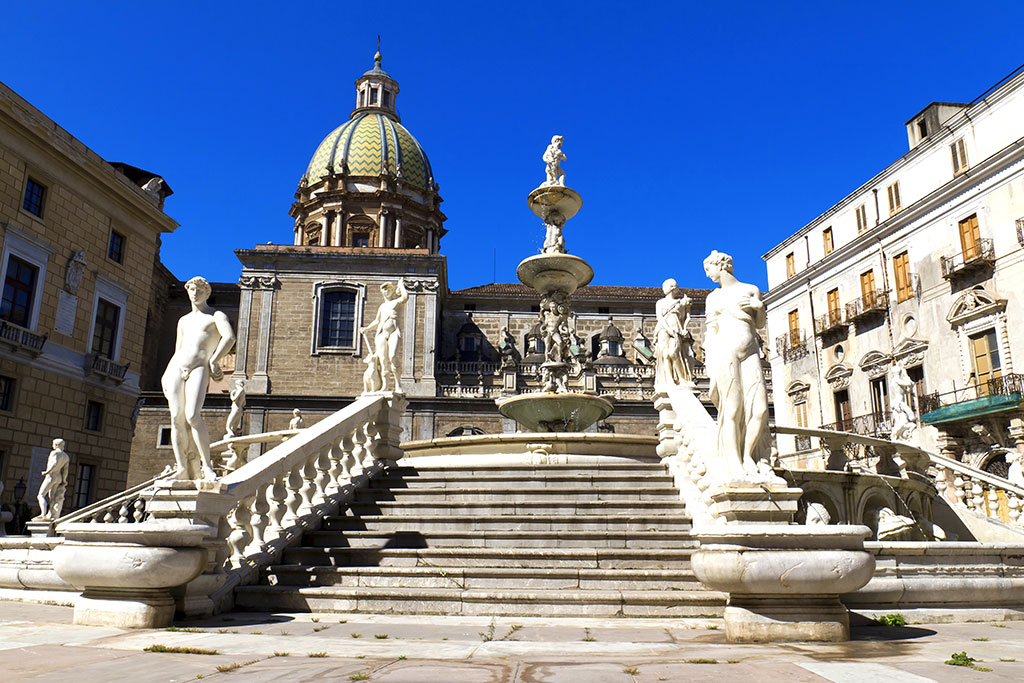
In Palermo’s Piazza Pretoria — dominated by the sixteenth-century fountain that locals have long called the fontana della vergogna, the fountain of shame, for the nudity of its figures — the morning has a slightly more urban rhythm, but the fundamentals are the same. These squares are designed for people-watching, and an hour spent simply sitting and observing, before the midday heat settles in and the shutters come down, will tell you more about a town than most guided tours.
Volcanic Soil and the Logic of the Market
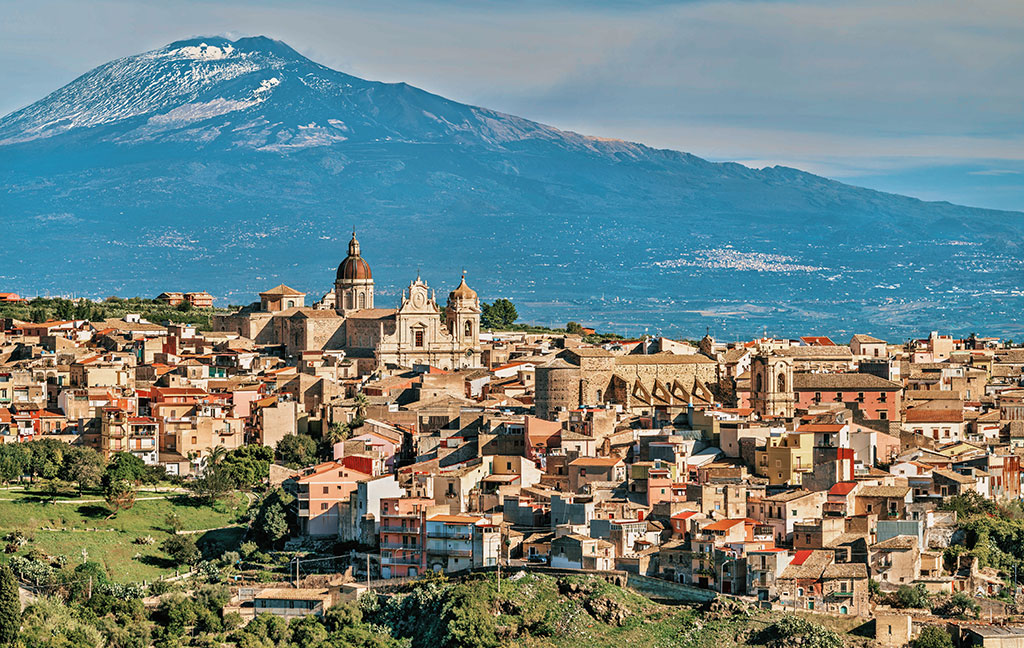
Sicily’s food is inseparable from its geology. The land around Mount Etna is some of the most mineral-rich in Europe, the result of centuries of eruptions depositing layers of basalt and ash across the lower slopes. The citrus groves here produce fruit with a sharpness and depth that’s noticeably different from what grows in flatter, more irrigated land elsewhere. The Bronte pistachios — cultivated on the northwestern slopes of the volcano in small terraced plots — have a particular intensity that makes them taste less like a nut and more like an argument. The vineyards on Etna’s slopes have, over the past decade or so, attracted serious attention from winemakers across Europe, drawn by the combination of ancient indigenous varieties, extreme altitude, and that volcanic soil. Nerello Mascalese, grown on vines that in some cases predate the twentieth century, produces a red that is pale in colour, high in acidity, and unlike almost anything made on the mainland.
To see the food culture at close range, go to a market. La Pescheria in Catania — held every morning except Sunday in the streets behind Piazza del Duomo — is the most visceral introduction the island offers to its own relationship with what it eats. It is loud, crowded, and operates at a pace that feels slightly faster than the rest of the city. Swordfish and tuna are laid out on marble slabs, their flesh the deep red of something caught that morning.
Vendors work in a performance style that is part sales technique, part theatre — singing out prices, holding up fish by the tail, conducting an ongoing commentary on the quality of the day’s catch. The exchange between vendor and buyer is rarely transactional in the plain sense; there is usually a question about how you plan to cook it, a suggestion, occasionally a mild argument. That interaction — the passing on of knowledge about provenance and preparation — is as much a part of the market as the produce itself.
Smaller markets in the interior towns operate more quietly but carry the same underlying logic. In Ragusa or Noto on a weekday morning, the stalls are set up in the shadow of baroque churches that took a century to build, and the farmers selling vegetables from the back of a van parked at the edge of the square have likely been coming to the same spot for most of their lives. Buying something, even something small, and asking where it’s from tends to open a conversation.
Staying Still: The Case for a Private Villa
For a trip of more than a few days, how you stay matters as much as where you go. A hotel provides comfort and convenience, but it also keeps you slightly apart from the place — your meals are set times, your movement is oriented around the property, and the rhythms of the establishment gradually start to feel like the rhythms of your day. A private villa inverts this. It gives you a home base with its own logic: a kitchen where you can bring back what you bought at the market, a terrace for a long lunch that doesn’t end because someone needs the table, a routine that you build yourself.
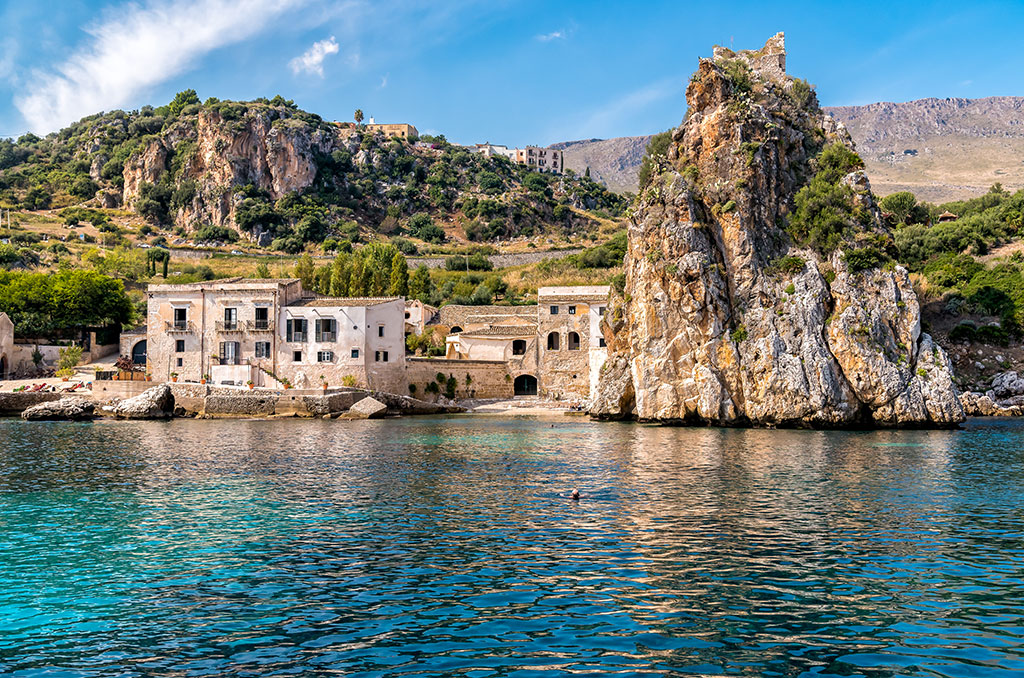
To discover more about villas in Sicily, it is best to focus on properties located within traditional towns or near farming hubs like Scopello or Ragusa. Staying near Scopello, on the northwestern coast, puts you within reach of the Zingaro Nature Reserve and a small fishing village that has changed remarkably little in the past fifty years. The Ragusa Iblea area in the southeast — the baroque hilltop town used extensively as a film location, its streets still recognizable from the long-running television series shot there — is surrounded by working farms and has a quieter, more residential character than the coastal tourist centres.
Properties in these areas, particularly those within a neighbourhood rather than set apart from it, tend to produce the particular experience of buying your morning espresso at the same bar as the people who live there — not as a curated encounter, but simply because it’s the nearest bar and it’s where everyone goes.
For families or groups, the practical advantages are straightforward: the space, the privacy, the ability to eat at your own pace. But the more interesting argument for a villa is the one about immersion. When your accommodation is a house in a town rather than a room in a resort, the town becomes part of your daily life in a way that changes how you see it.
The Passeggiata: Evening as Social Event
Between roughly five in the afternoon and eight in the evening, Sicilian towns change character entirely. The work day ends, the heat begins to lift, and the streets fill with people moving slowly and deliberately through the main thoroughfares. This is the passeggiata, the ritual evening stroll, and it is one of the most consistent and legible expressions of how life is organized here.
It is not, or not only, a walk. It is the primary social event of the day: the moment when news circulates, when people assess and are assessed, when the community checks in with itself. Everyone participates — children, teenagers, elderly couples, middle-aged groups of friends — and most people are dressed with a care that signals they regard this as a public occasion. In smaller towns, the route is usually fixed: the same street or the same circuit around the piazza, walked slowly enough that you can stop and talk without disrupting the flow.
For a visitor, the instinct is often to treat this time as a gap between activities — the window before dinner when you might have a drink or check your phone. The better approach is to put the phone away and join the movement. Not as an observer, but as a participant, even an awkward one. Walk slowly. Stop when people stop. Let the evening happen at its own pace.
What you notice, gradually, is the density of social interaction, the number of separate conversations beginning and ending in a short stretch of street, the way people who have known each other their entire lives still seem genuinely pleased to run into each other. It is, among other things, a reminder that public life can be something people actively choose rather than merely endure.
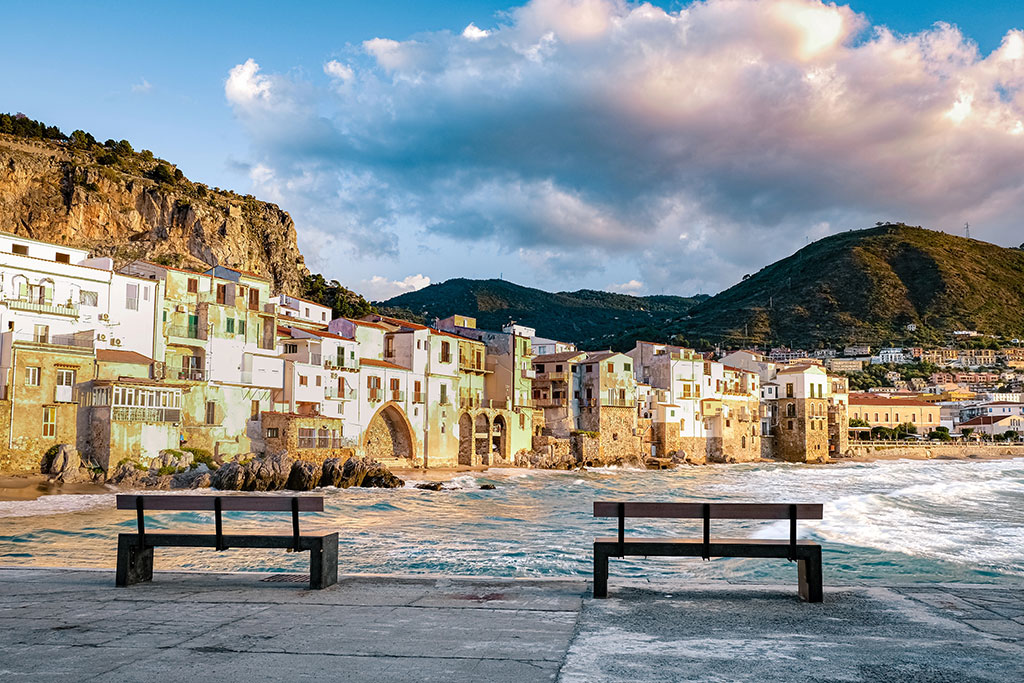
The passeggiata also functions as a useful corrective to the tourist’s tendency to treat Sicily primarily as a landscape or an archive. The ruins and the baroque churches are extraordinary, and they deserve time. But the island’s culture is not only in its past. It is also in the way people arrange the present — in the specific social choreography of an evening in Noto or Modica or Cefalù, which has been refined over a very long time and which, if you pay attention, is as interesting as anything in the guidebook.
What the Island Is Actually Offering
Sicily works best when understood as a composite of Greek and Arab and Norman and Spanish histories layered into something that doesn’t resolve cleanly into any of them, of a volcanic interior that shapes the taste of the food and the character of the landscape, of a social culture built around the piazza and the passeggiata and the particular density of community life in small towns.
Arranging private tours in Sicily is a practical way to connect these historical dots. Having a professional guide explain how the island’s identity was shaped across these eras turns a standard walk through the city into a deep dive into Mediterranean history. None of this is hidden or difficult to access. It is, in most cases, happening in plain sight in the main square of whatever town you happen to be in.
The question is whether you’re moving fast enough to miss it, or slowly enough to see it.
* Cover photo by Freesurf* via Depositphotos